.png)
TL;DR
No single trade tells you anything meaningful — your edge only shows up across a large sample
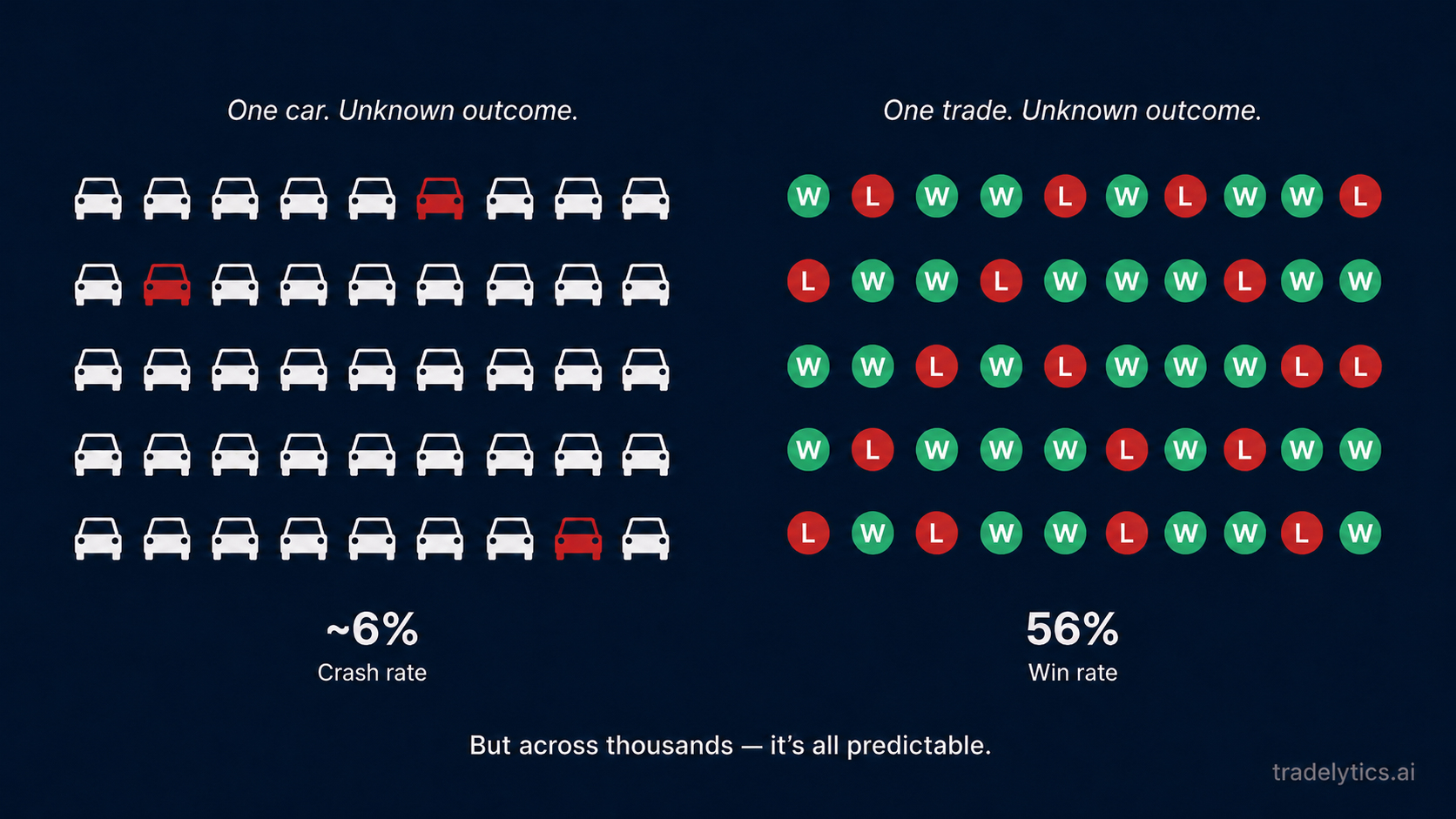
Insurance companies don't know which car crashes. They know how many will. Traders need the same mindset.
30 trades minimum before changing anything — one bad week is noise, not signal
Backtesting builds your baseline; journaling reveals the variables that move your numbers
The goal isn't to predict every trade — it's to tilt the odds consistently in your direction
You had a solid setup. Followed your rules. Still lost. And now you're questioning everything. That's the trap. And it's costing you far more than that one trade ever did.
The Problem
The real damage isn't the loss itself — it's what happens after. Most traders start dismantling their strategy the moment it doesn't perform on a single trade. They tighten the stop. Change the entry trigger. Sit out the next three setups "just to watch." What was actually working gets torn apart in real time, trade by trade, based on a sample size of one. The system doesn't fail them — they abandon it before it ever had a chance to prove itself.
Why It Happens
Our brains are wired to find meaning in individual events. Win a trade and your strategy is brilliant. Lose one and something must be broken. That's how humans think. It's also exactly backwards from how trading works.
There is no way to know, going into any single trade, whether it will be a winner or a loser. Not with the cleanest setup you've ever seen. The market doesn't owe you anything on one trade.
But zoom out, and something completely different starts to happen.
Think about how insurance companies operate. They have no idea which specific car will get into an accident this year. Not yours, not mine — nobody's. But they can tell you, with remarkable precision, what percentage of insured cars across a large population will. And they've spent decades isolating the variables that shift that number: underage drivers, aggressive driving history, zip codes with higher accident rates, the age and price of the car. They don't predict single events. They understand patterns across large numbers. That's what makes them consistently profitable year after year.
Trading is the same game. On any single trade, you don't know the outcome. But across 50, 100, 200 trades? Your P&L becomes far more predictable than it feels in the moment. The question isn't "will this trade win?" It's "what does my approach actually do across a large sample?"
The Fix
Start by establishing your baseline — that's where backtesting earns its place. Run your primary setup through historical data. Not to find a perfect system, but to understand what your approach actually does: win rate, average winner versus average loser, how it behaves in different market conditions. That's your foundation. Without it, you're flying blind and calling it intuition.
Once you have a baseline, the next job is identifying your variables — the equivalent of what insurance companies figured out about underage drivers. Time of day you trade. The specific setup type. Whether you're trading with or against the broader trend. Whether you took the trade thirty seconds after a losing trade because you wanted to get it back. Every one of these factors can inflate or deflate your edge — you just don't know which ones until you track them consistently.
Your edge isn't in predicting individual trades — it's in understanding what your approach does across enough of them to matter.
This is where a trading journal stops being optional and becomes genuinely useful. Not as a diary — as a data set. When you log your trades and tag them with the right variables, patterns surface. You'll notice your A+ setups in the morning hit at a completely different rate than the same setup taken at 2pm. You'll see that trades taken immediately after a loss underperform across the board. That's not intuition anymore. That's your own data telling you what to do more of and what to cut.
The hardest discipline in all of this is staying patient with the process. Three losses in a row is not a signal — it's noise. Tweaking your plan on a trade-by-trade basis doesn't refine your strategy. It destroys the one you already have before it ever had a real chance to show you what it could do.
Put It Into Practice
→ A single result is one data point. Stop treating losses like evidence and wins like proof.
→ Your job is to execute your process consistently and let the math work over time.
→ Patterns only show up if you track long enough — and honestly enough — to see them.